
lasciate un messaggio
Se siete interessati ai nostri prodotti e desiderate maggiori informazioni, lasciate un messaggio qui; vi risponderemo il prima possibile.



RFID in Agriculture: Transforming Traditional Farming into Smart Agriculture
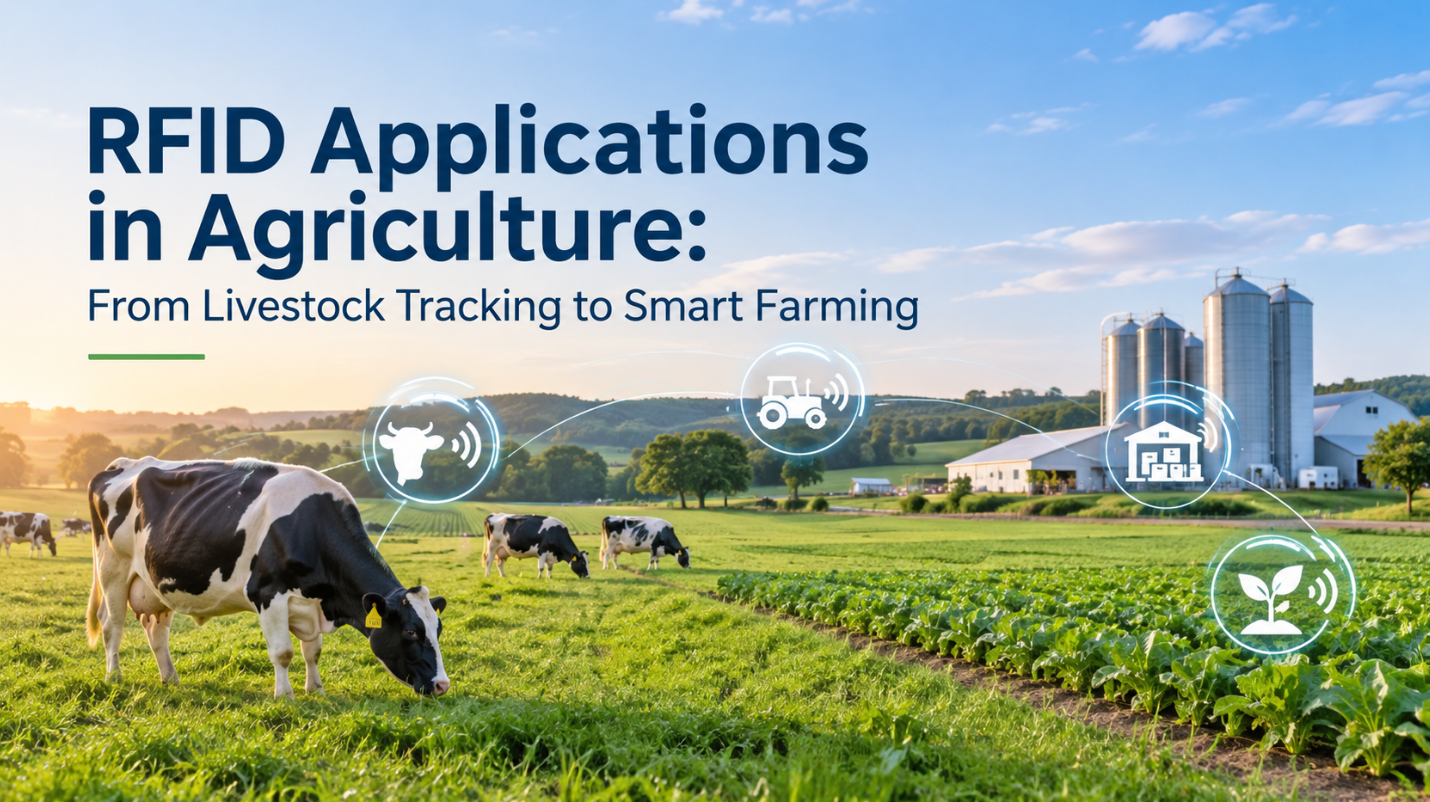
Agriculture is undergoing a major transformation as digital technologies become increasingly important in modern farming. Traditional agricultural management often relies on manual record-keeping, visual inspections, and labor-intensive processes. These methods can make it difficult to monitor large farms, track livestock, manage agricultural equipment, and maintain accurate production records. As agricultural operations continue to expand, farmers need more efficient and reliable ways to collect information and manage resources.
Radio Frequency Identification (RFID) technology provides an effective solution to these challenges. By using radio waves to identify and track tagged objects automatically, RFID enables real-time data collection without requiring direct visual contact or manual scanning. It can be applied to livestock identification, crop management, agricultural equipment tracking, inventory control, and food supply chain traceability.
With the integration of RFID readers, RFID tags, antennas, and farm management software, agricultural businesses can improve operational efficiency, reduce labor costs, and achieve more accurate resource management. RFID is becoming an important technology in the development of smart agriculture.
Livestock management is one of the most established applications of RFID in agriculture. On large farms, identifying individual animals and maintaining accurate records can be challenging, particularly when hundreds or thousands of cattle, sheep, or pigs need to be monitored.
RFID ear tags and electronic identification devices provide each animal with a unique identification number. When an animal passes through an RFID reading area, an RFID reader automatically captures the tag information and transfers it to a farm management system.
This allows farmers to establish digital records for individual animals, including birth dates, breed information, vaccination history, feeding records, weight changes, and reproductive status.
For example, cattle farms can install RFID readers at feeding stations, weighing platforms, and farm entrances. When an animal passes through these areas, the system automatically identifies it and records relevant information. Farmers can use this data to monitor growth, evaluate feeding performance, and identify animals that may require additional attention.
RFID also plays an important role in disease prevention. By maintaining detailed identification and movement records, farms can quickly locate animals that have been exposed to infectious diseases. This improves disease control and supports more effective livestock traceability.
Although RFID is widely associated with livestock identification, it also offers valuable applications in crop production.
Modern agricultural production involves managing seeds, fertilizers, pesticides, harvesting equipment, and other resources. Without an effective tracking system, it can be difficult to maintain accurate records of material usage and production activities.
RFID tags can be attached to seed containers, fertilizer storage units, pesticide packages, and reusable agricultural containers. RFID readers installed in storage areas and processing facilities can automatically identify these items and record their movement.
For example, when fertilizer is delivered to a farm warehouse, an RFID system can record its product information, batch number, storage location, and receiving date. When the fertilizer is transferred to a field operation, the system can update its inventory records.
This helps agricultural managers understand how resources are distributed and used across different production areas.
RFID can also support the management of crop-growing equipment and planting materials. By connecting RFID identification data with agricultural management software, farms can establish more standardized production records and improve the efficiency of daily operations.
Agricultural machinery represents a significant investment for farming businesses. Tractors, harvesters, irrigation equipment, seeders, and other tools must be properly maintained and efficiently allocated.
On large farms, equipment is frequently moved between fields, storage areas, and maintenance facilities. Manual tracking can lead to misplaced tools, inefficient scheduling, and unnecessary equipment purchases.
RFID technology provides an automated approach to agricultural asset management. RFID tags can be installed on machinery, tools, spare parts, and equipment containers. Fixed RFID readers can be positioned at warehouse entrances, maintenance workshops, and designated equipment storage areas.
When tagged equipment enters or leaves a reading zone, the system can automatically record its movement. Managers can use this information to understand equipment availability, usage frequency, and storage locations.
For example, a large agricultural enterprise operating across multiple fields can use RFID to track tractors and harvesting equipment as they move between different working areas. The collected data helps managers coordinate equipment allocation and reduce unnecessary transportation.
RFID can also be combined with maintenance management systems. By associating equipment identification information with maintenance records, operators can access service histories, inspection schedules, and replacement part information more efficiently.
Agricultural warehouses store a wide range of materials, including seeds, fertilizers, pesticides, animal feed, spare parts, and harvested products. Maintaining accurate inventory is essential for ensuring continuous agricultural operations.
Traditional inventory management often depends on manual counting and barcode scanning. These methods can be time-consuming, especially when large quantities of products are stored in different locations.
UHF RFID technology allows multiple tagged items to be identified simultaneously without requiring individual visual scanning. RFID readers equipped with suitable antennas can capture tag information as products pass through warehouse entrances or designated inventory areas.
For example, when a batch of agricultural products arrives at a warehouse, RFID readers can automatically identify the tagged containers and update the inventory database. During outbound operations, the system can verify product information and record shipment details.
RFID can also improve the management of pesticides and fertilizers by recording product batches, expiration dates, and storage locations. This helps reduce the risk of expired materials being used and supports better inventory rotation.
For agricultural businesses handling large volumes of products, RFID-based inventory management can significantly reduce manual workload while improving stock accuracy and warehouse efficiency.
Food safety and product traceability have become increasingly important to consumers, retailers, and regulatory authorities. Agricultural products often pass through several stages, including planting, harvesting, processing, packaging, transportation, and retail distribution.
Without reliable data collection, it can be difficult to determine where a product originated or identify the production batch associated with a quality problem.
RFID technology helps establish a more transparent agricultural supply chain by connecting physical products with digital information.
RFID tags can be attached to reusable containers, pallets, cartons, or individual product packages, depending on the application and cost requirements. As products move through different stages of the supply chain, RFID readers automatically collect identification information and update the corresponding records.
For example, a vegetable producer can use RFID to associate harvested products with specific fields, harvesting dates, and production batches. When the products enter a processing facility, RFID readers identify the containers and record their arrival times. During distribution, the system continues tracking product movements.
If a quality issue occurs, managers can use the recorded information to identify the affected batch and determine its distribution history. This makes product recalls more targeted and efficient.
RFID can also work alongside QR codes, barcodes, temperature sensors, and other IoT technologies to provide more comprehensive agricultural traceability.
The development of the Internet of Things (IoT) has created new opportunities for RFID applications in agriculture.
RFID primarily provides automatic identification and data collection, while IoT sensors can monitor environmental conditions such as temperature, humidity, soil moisture, and light intensity.
When these technologies are integrated, agricultural managers can obtain more comprehensive information about farm operations.
For example, RFID can identify fertilizer containers and record their distribution, while IoT sensors monitor soil conditions in different fields. By connecting these data sources through a centralized management platform, farmers can better understand the relationship between agricultural resource usage and environmental conditions.
In livestock farming, RFID can identify individual animals, while wearable sensors monitor activity levels, body temperature, or other health-related indicators. This combination helps farmers detect abnormal conditions earlier and make more informed management decisions.
RFID readers can also be connected to cloud-based platforms through Ethernet, Wi-Fi, or 4G/5G networks. This allows agricultural enterprises to access operational information remotely and manage multiple farms through a centralized system.
Different agricultural environments require different RFID solutions. Selecting suitable RFID equipment is essential for achieving reliable identification performance.
First, the RFID frequency should match the application. LF and HF RFID technologies are commonly used for specific animal identification and short-range applications. UHF RFID is particularly suitable for warehouse inventory, equipment tracking, pallet identification, and applications requiring longer reading distances or multiple-tag identification.
Second, environmental conditions must be considered. Agricultural equipment is frequently exposed to dust, rain, moisture, temperature fluctuations, and outdoor conditions. Therefore, RFID tags and readers should have suitable protection ratings and environmental resistance.
Third, antenna performance is important. Different agricultural applications require different reading areas. Directional RFID antennas can provide more focused coverage, while circularly polarized antennas are useful when tag orientation is unpredictable.
Finally, system compatibility should not be overlooked. RFID readers should support appropriate communication interfaces, such as RS232, RS485, Ethernet, or Wi-Fi, depending on the system architecture. SDKs and software integration capabilities are also important for connecting RFID hardware with existing farm management platforms.
A well-designed RFID solution should be selected according to the actual application environment, identification distance, tag type, reading speed, and data management requirements.
The adoption of RFID technology brings several practical benefits to modern agriculture.
First, it reduces manual operations. Automatic identification allows farmers to collect information without repeatedly checking labels or entering data manually.
Second, RFID improves data accuracy. Automated data collection reduces human errors in livestock identification, warehouse inventory, and equipment management.
Third, it increases operational transparency. Agricultural managers can obtain more accurate information about animal records, material consumption, equipment movement, and product distribution.
Fourth, RFID supports better decision-making. By collecting and analyzing operational data, farms can identify inefficiencies, optimize resource allocation, and improve production planning.
Looking ahead, RFID will continue to develop alongside artificial intelligence, IoT, cloud computing, and big data technologies. More agricultural operations will adopt integrated digital management platforms that connect livestock, equipment, warehouses, and supply chains.
As RFID hardware becomes more flexible and affordable, its applications are expected to expand from large agricultural enterprises to medium-sized and specialized farms.
RFID technology is playing an increasingly important role in the digital transformation of agriculture. From livestock identification and crop production management to equipment tracking, warehouse inventory, and food traceability, RFID provides reliable automatic identification and data collection capabilities.
By integrating RFID readers, antennas, tags, and intelligent management software, agricultural businesses can reduce labor requirements, improve management accuracy, and establish more transparent production processes.
As smart agriculture continues to evolve, RFID will become an increasingly valuable tool for building efficient, connected, and sustainable agricultural operations. For agricultural equipment manufacturers and solution providers, developing RFID systems that meet the practical needs of different farming environments will create new opportunities in the global smart agriculture market.

Informazioni dettagliate e PDF

Contatto e-mail per l'assistenza.

Consulenza tecnica professionale.

Contatto e-mail per l'assistenza.


Bomba

COLLEGAMENTO

Comunicato

lasciate un messaggio
Scansiona e invia a WeChat/WhatsApp :



 IPv6 SUPPORTO DI RETE